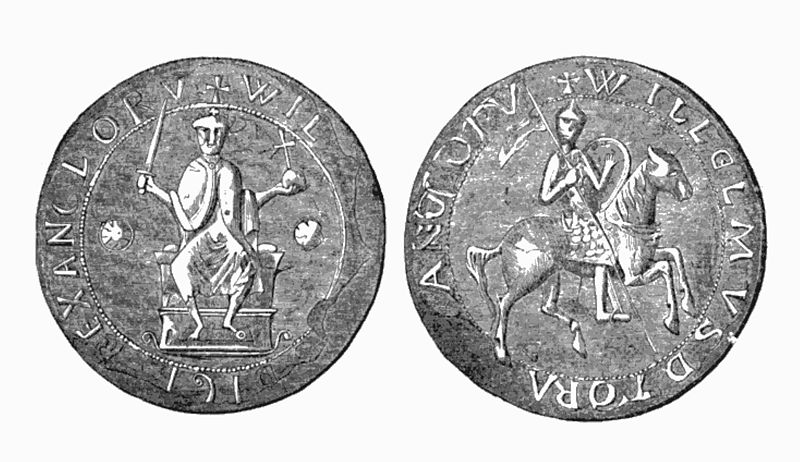
Under Huntingdon’s quill, Henry’s I legacy as king is not much better than that of his brother's. Both the Historia Anglorum and the Anglo-Saxon Chronicle recount several stories about Henry I’s ruthlessness – even with his own family. In one instance, Henry’s son-in-law Eustace, married to one of the king's illegitimate daughters Juliane, exchanged children with a constable Ralph Harnec. Though the idea seems appalling to the modern reader, medieval families often surrendered children or family members as hostages, ensuring that neither party would break a treaty for fear their children would be slain. When Eustace inexplicably had Harnec’s children blinded, Ralph appealed to the king. Henry commanded that Eustace and Juliane’s girls – his own grandchildren – also be blinded. When Henry showed up at his daughter’s residence, she met her father and threatened to kill him with a crossbow.
Actions such as these meant Henry's subjects feared him as a harsh ruler. In 1125, England was in the midst of a financial crisis; grain prices elevated sharply. Huntingdon recounts Henry’s response to the economic problem almost gleefully: “It is rewarding to hear how severely the king was towards wicked men. For he had almost all the moneyers throughout England castrated and their right hands cut off for secretly debasing the coinage. This year was the most expensive of all in our times, when a horse’s load of corn was sold for 6s.”[3]
While Huntingdon admires Henry’s political maneuverings – including his wars with France – he accuses the king of three vices, “excessive greed…cruelty…debauchery.” In this instance, however, the chronicler is not implicating the king in sodomy, but rather, adultery, “Since he was at all times subject to the power of women, after the manner of King Solomon.”[4] In sum, Henry had some twenty to twenty one illegitimate children and two legitimate children. The legitimate male heir, also named William, should have been king, but his death in 1120 in the White Ship incident – a drowning at sea, left the country without a legitimate successor. In this matter, Huntingdon again weighs in with divine justice, placing the blame not on the drunken helmsman who hit rocks, but on the passengers: “All of them, or nearly all, were said to be tainted with sodomy and they were snared and caught. Behold the glittering vengeance of God! They perished and almost all of them had no burial. And so death suddenly drowned those who had deserve it, although the sea was very calm and there was no wind.”[5]

William, son of Henry I, lost at sea (la mer)
Bereft of his son, Henry tried to have his only surviving legitimate child, Matilda, pronounced rightful heir to the throne. As a members of a male-dominated society, the English barons refused a woman on the throne. Inheritance was the financial backbone of medieval economic society; the problem of succession led to even more family problems for the aging king. In 1135, Henry stayed with his daughter Matilda and her second husband, the Count of Anjou, in Normandy. The visit, according to Huntingdon, was less than genial “due to the machinations of none other than the king’s daughter.”[6]

Matilda, daughter of Henry I
At some time during his sojourn in Normandy, Henry dined on one of his favorite meals, a “surfeit of eels,” in Huntingdon’s words.[7] The “eel” here is a lamprey, a bottom-dwelling parasitic fish. Henry apparently gorged on them and died December 1, 1135.

Lampreys, favorite meal of Henry I and potential cause of his death
Huntingdon has an extraordinarily detailed account of Henry’s corpse, transcribed here in its entirety:
“Meanwhile, the body of King Henry was still unburied in Normandy. He had died on the first day of December [in 1135]. His body was brought to Rouen, and there his entrails, brains, and eyes were buried together. The remainder of the corpse was cut all round with knives, sprinkled with a great deal of salt, and wrapped in oxhides to stop the strong, pervasive stench, which was already causing the death of those who watched over it. It even killed the man who had been hired for a great sum of money to cut off the head with an axe and extract the stinking brain, although he had wrapped himself in linen cloths around the head: so he got no benefit from his fee. He was the last of many whom King Henry put to death…
“They took the royal corpse to Caen, and it lay there for a time in the church in which his father had been buried. Although it had been filled with salt and wrapped in many hides, a fearful black fluid ran down continuously, leaking through the hides, and was collected in vessels beneath the bier and cast away by attendants who grew faint with dread. See, then, whoever you are reading this, how the corpse of a most mighty king, whose crowned head had sparkled with gold and the finest jewels, like the splendor of God, whose hands had shone with sceptres, while the rest of his body had been dressed in gorgeous cloths of gold, and his mouth always fed on the most delicious and choice foods, for whom everyone would rise to their feet, whom everyone feared, with whom everyone rejoiced, and whom everyone admired: see what that body became, how fearfully it melted away, how wretchedly cast down it was! See, I say, the outcome of events, upon which final judgment always depends. And learn to hold in contempt whatever comes to such an end, whatever is reduced to nothing in this way.”[8]
While Huntingdon again attributes the state of decay to Henry’s sinfulness, even concluding his thoughts on the dead king by saying he was “at all times dedicated to cupidity and avarice,” modern pathology provides insight into this nearly-millennium old text. In fact, the stages Huntingdon describes here closely follow the five stages of decay, known as the fresh stage, putrefaction, black putrefaction, butyric fermentation, and dry decay, although Henry’s body was interred after December 25 of 1135. The cold, wet temperatures of the Norman winter, the oxhide shroud, and the cold stone bier would have prolonged stages two and three, especially the putrefaction, the stage of rot that includes the “fearful black fluid” Huntingdon describes as leaking from the oxhide shroud.
Animal decay begins in the abdominal cavity, with bacteria in the gastrointestinal tract forming post-mortem growth. The king’s sickness, and the presence of a fever due to the feast of lampreys, would have certainly encouraged bacterial growth. Once this stage began, the resulting darkening of the king’s skin, the liquefaction of his tissues and organs, and the strong stench of death that overpowered the attendants all make scientific sense. What Huntingdon describes here – but does not understand – is the natural post-mortem condition.

Henry's tomb, Reading Abbey, Berkshire
Unable to comprehend these events, Huntingdon blames the king’s death state as indicative of his sinful life. When the king’s nephew Stephen seized the throne in 1135, thrusting the country into a period of civil war known as “the Anarchy,” the medieval chronicler and archdeacon only grew more despondent about the sins that seemed to follow William the Conqueror’s line, revising the Historia Anglorum with a hexameter titled “On Contempt for the World.”
Sin or science? Medieval-csi values your input. Weigh in on the comments section.
Next week: Medieval vampires
[1] Henry of Huntingdon. History of the English People 1000-1154. Trans. Diane Greenway. London: Penguin, 1996, 2002: 33.
[2] Ibid, 48.
[3] Ibid, 58.
[4] Ibid, 65.
[5] Ibid, 56. It should be noted here that there were female passengers, including William’s wife, about the ship and that sodomy did not just refer to male-male intercourse.
[6] Ibid, 64.
[7] Huntingdon is the first to make mention of the death by eels, but this is unsurprising since he had firsthand testimony from the court to make such a claim. Geoffrey of Monmouth, who composed his Historia Regum Britanniae (History of the Kings of Britain) during Henry’s reign, makes no mention of Henry’s death by lamprey, nor does he chide the dead king for his vices. However, Monmouth also dedicates his work to Robert, one of Henry’s sons, so his motivation for composing his history – as well as its contents – varies greatly from Huntingdon’s.
[8] Ibid, 66-7.