In 2006, archeologists excavating a mass grave of sixteenth-century plague victims came across a striking skeleton. Its jaws were pried open, and a brick was inserted into the mouth. The team insisted they had chanced upon a so-called “deviant burial” – the intentional manipulation of a corpse to punish or to prevent it from engaging in post-mortem haunting. Intriguingly, this was not the first European skull to have been altered in such a way. Last week, archaeologists in Ireland revealed their findings: two male skeletons dating to the eighth century who had black stones shoved into their mouths.[1]

Venetian "vampire" skull, c. 16th century
Both teams extrapolated the obstruction of these skeletons’ mouths as evidence of a form of revenant insurance, preventing these so-called “shroud eaters” or “chewing dead” from causing further death, infection, or destruction to the living and the dead, since it was believed these vampires would initially chew through their own shrouds, then through their digits before moving on to other corpses or the living.[2] The skeletons are a testament to a pervasive human fear of being consumed by the dead.

John Collier's Lilith
One of the earliest allusions to human-like creatures who prey upon humans surfaced in Sumerian mythology, in ki-sikil-lil-la-ke, or Lilith, the figure of a female goddess or demon who did not have benign motives when it came to humanity. Allusions to Lilith in the Old Testament proper surface only once, in Isaiah 34: 13-16, where her name translates to night owl or screech owl:
“And thorns shall come up in her palaces, nettles and brambles in the fortresses thereof: and it shall be an habitation of dragons, and a court for owls. The wild beasts of the desert shall also meet with the wild beasts of the island, and the satyr shall cry to his fellow; the screech owl also shall rest there, and find for herself a place of rest. There shall the great owl make her nest, and lay, and hatch, and gather under her shadow: there shall the vultures also be gathered, every one with her mate. Seek ye out of the book of the LORD, and read: no one of these shall fail, none shall want her mate: for my mouth it hath commanded, and his spirit it hath gathered them.”
Once haunting the medieval mind, the vampire continued to prey on it through the Renaissance. The Lilith myth expanded, and she was suspected of preying not just upon men and causing nocturnal emissions, but also of causing deaths during pregnancies.

Max Schreck as Nosferatu, 1922

First edition of Dracula, 1897

St. Michan's Church remains
These theories are secondary to what Stoker does present readers with in Dracula: the Victorian continuation of medieval and Renaissance vampire mythos and its relationship with what we today understand from forensic science. In the novel, Stoker describes the Count’s horrifying crypt, as exposed by Jonathan Harker:
“I knew I must reach the body for the key, so I raised the lid, and laid it back against the wall. And then I saw something which filled my very soul with horror. There lay the Count, but looking as if his youth had been half restored. For the white hair and moustache were changed to dark irongrey. The cheeks were fuller, and the white skin seemed ruby-red underneath. The mouth was redder than ever, for on the lips were gouts of fresh blood, which trickled from the corners of the mouth and ran down over the chin and neck. Even the deep, burning eyes seemed set amongst swollen flesh, for the lids and pouches underneath were bloated. It seemed as if the whole awful creature were simply gorged with blood. He lay like a filthy leech, exhausted with his repletion…” [4]
In a later scene, while Lucy lies on her deathbed after being attacked by Dracula, Stoker writes,
“She was ghastly, chalkily pale. The red seemed to have gone even from her lips and gums, and the bones of her face stood out prominently… There on the bed, seemingly in a swoon, lay poor Lucy, more horribly white and wan-looking than ever. Even the lips were white, and the gums seemed to have shrunken back from the teeth, as we sometimes see in a corpse after a prolonged illness.”[5]
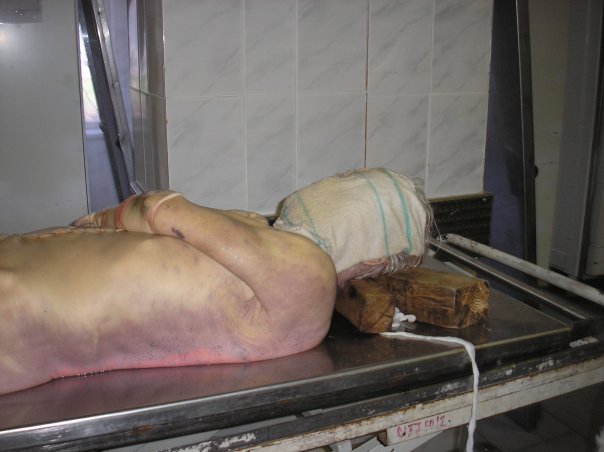
Liver mortis, with coagulated blood pooling
Both scenes are resplendent with descriptions of the natural decomposition process – a process Victorians understood about as well as people living during the Middle Ages. Stoker’s description of the blood-sated Count as “gorged with blood,” for instance, is a common observation of an exposed “vampire.” This event, however, is a stage of liver mortis, where coagulating blood tends to settle in areas of the body, making it appear ruddy. Additionally, the fear that a corpse was feasting on human prey and could appear plump after death is another decomposition process caused by gases excreted by the bacteria aiding in decay.
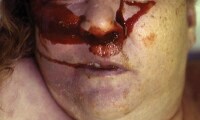
The description of “gouts of fresh blood” along Dracula’s lips was also considered evidence of vampirism in a corpse. If a vampire were staked, medieval and Renaissance witnesses even testified that fresh blood would ooze from the mouth and nose. Modern science can explain this post-mortem reaction through blood hydraulics. Even after death, the body continues to remain active, with bacteria aiding the decomposition process. As the body decomposes, it becomes more liquefied; the runoff from the orifices is called purge fluid. An example of this process appears in the image below; please be advised that it is for mature readers:
http://img.medscape.com/pi/emed/ckb/pathology/1603817-1607640-1680032-1714502tn.jpg
http://img.medscape.com/pi/emed/ckb/pathology/1603817-1607640-1680032-1714502tn.jpg
Stoker’s description does appear to have some connection with notorious diseases of the age, including cholera and tuberculosis (consumption), but the connection of Lucy’s appearance to that of “a corpse after a prolonged illness” is also telling. Specifically, Lucy’s gums and exposed teeth are identical to many medieval and Renaissance testimonies about the vampire’s “fangs.” Again, modern forensics helps to dispel the superstition. As a corpse passes through the liquid stage and begins to desiccate, the lips and gums recede, exposing the teeth. This stage is fairly prominent in many Victorian death photos.
Another sign of vampirism – the fresh appearance of a corpse – can be explained only by varying rates of decay. In colder European climes such as the mountains of Romania, a corpse buried in the winter would essentially be frozen for several months. Disinterred, it would likely appear to be almost uncorrupted. This explanation obviously would not rule out every vampire case, but it does help to explain how frozen, infertile soil could breed so many vampires.
Modern pathology studies have attempted to explain vampirism as the result of several diseases, including sexual deviancy (as in the Báthory case), rabies, porphyria, tuberculosis, or pellagra. These theories are largely insufficient since they only describe side effects that mimic vampire behavior, including sensitivity to sunlight or strong smells. What all vampire stories have in common – whether “true” testimonies or Stoker’s tale – is post-mortem descriptions or decay.

Antoine Weirtz, The Premature Burial
Two other vampire signifiers that so troubled denizens of the medieval ages to the Victorian age were live burials and the absence of a corpse that had clearly been buried. If a patient in these periods were to go into a coma or suffer from an illness that caused a weak or fluctuating pulse, there were no reliable indicators to show signs of life. There remained a lingering fear that one might be buried alive. Victorians were obsessed with this idea – indeed, Edgar Allen Poe set it to type in his “Fall of the House of Usher” – and even developed a bell that was tied to a rope within a coffin, so that a revived person would be able to signal for help.

Bell and coffin device
Especially troubling for men and women of these earlier ages was the missing corpse. During the medieval era and Renaissance, bodies could not always be buried at the depths of modern ages. The likelihood of animals digging up a corpse and dragging it away was high. Likewise, the Victorian age had its own fears of corpses disappearing – or indeed, even being turned into a corpse before one’s time – due to body snatching or “burking.” Named for William Burke, burking was the intentional compression of a victim until he or she died of suffocation. Burke and his partner, William Hale, were convicted of seventeen murders-for-the purpose of selling corpses for anatomical research; they were executed in 1829.

The Execution of William Burke, 1829
As recently as 1929, occultist Montague Summers insisted that vampires were real. This insistence stood in the face of two hundred years of papal denial of the existence of the creatures and stood on the cusp of modern forensics and observation of death, something Europe observed all-too-often in the upheaval of World War I and the Bolshevik revolution. Although modern science can account for much of what earlier ages observed as vampirism, we remain captivated by the idea of this blood-sucking monster of the night.
Medieval-csi values your input. Weigh in on the comments section.
Next time: On the margins: leprosy
[1]See: http://www.telegraph.co.uk/news/worldnews/europe/italy/4959363/Mediaeval-vampire-skull-found-in-near-Venice.html
and
[2] In the interests of following the scientific method, it should be noted that the female skeleton excavated from a Venetian cemetery holding tens of thousands of skeletons from two plague outbreaks, with 40,000 skeletons from the second outbreak covering her remains. Though this theory of early modern vampirism has been promoted by the National Geographic channel, I question the hasty assumption that one single skeleton out of tens of thousands was accused of vampirism. Due to the age of the woman at death – around 70, according to the archeological team – there is a possibility that she was marked not for vampirism, but for spreading disease prior to her death or for being a gossip, since women were punished for such offenses with attacks on their mouths or jaws. In the case of the two eighth-century Irish skeletons, the case is stronger since the two skeletons buried together have been meted out with the same post-mortem “punishment.”
[4] See Stoker’s Dracula, C. 4
[5] Ibid, C.10